According to Auguste Comte, What Is the Job of the Sociologist?
| Auguste Comte | |
|---|---|
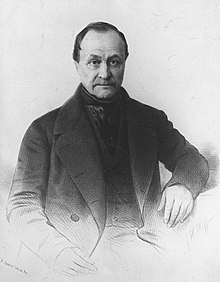 Comte in 1849 | |
| Born | Isidore Marie Auguste François Xavier Comte (1798-01-19)19 Jan 1798 Montpellier, France |
| Died | 5 September 1857(1857-09-05) (aged 59) Paris, France |
| Education |
|
| Spouse(south) | Caroline Massin (m. 1825; div. 1842) |
| Era | 19th-century philosophy |
| Region | Western philosophy |
| Notable ideas |
|
| Influences
| |
| Influenced
| |
Isidore Marie Auguste François Xavier Comte (French: [o'ɡyst kɔ̃t] (  listen ); nineteen January 1798 – 5 September 1857)[v] was a French philosopher and author who formulated the doctrine of positivism. He is often regarded as the commencement philosopher of scientific discipline in the modern sense of the term.[half dozen] Comte'south ideas were also key to the development of sociology; indeed, he invented the term and treated that subject as the crowning achievement of the sciences.[7]
Influenced by the utopian socialist Henri de Saint-Simon,[five] Comte developed positive philosophy in an attempt to remedy the social disorder caused by the French Revolution, which he believed indicated imminent transition to a new grade of society. He sought to establish a new social doctrine based on science, which he labelled 'positivism'. He had a major affect on 19th-century thought, influencing the work of social thinkers such equally John Stuart Manufacturing plant and George Eliot.[viii] His concept of Sociologie and social evolutionism set up the tone for early on social theorists and anthropologists such as Harriet Martineau and Herbert Spencer, evolving into modern academic sociology presented past Émile Durkheim equally practical and objective social research.
Comte's social theories culminated in his "Religion of Humanity",[5] which presaged the development of not-theistic religious humanist and secular humanist organisations in the 19th century. He may besides have coined the give-and-take altruisme (altruism).[9]
Life [edit]
Auguste Comte was born in Montpellier,[5] Hérault on xix Jan 1798. After attending the Lycée Joffre[10] and so the University of Montpellier, Comte was admitted to École Polytechnique in Paris. The École Polytechnique was notable for its adherence to the French ideals of republicanism and progress. The École closed in 1816 for reorganization, however, and Comte connected his studies at the medical school at Montpellier. When the École Polytechnique reopened, he did not request readmission.
Following his return to Montpellier, Comte soon came to see unbridgeable differences with his Catholic and monarchist family and set off again for Paris, earning money by small-scale jobs.
In August 1817 he plant an apartment at 36 Rue Bonaparte in Paris'southward 6th arrondissement (where he lived until 1822) and after that year he became a student and secretary to Henri de Saint-Simon, who brought Comte into contact with intellectual order and greatly influenced his thought therefrom. During that time Comte published his first essays in the diverse publications headed by Saint-Simon, L'Industrie, Le Politique, and L'Organisateur (Charles Dunoyer and Charles Comte's Le Censeur Européen), although he would not publish nether his own proper noun until 1819'due south "La séparation générale entre les opinions et les désirs" ("The general separation of opinions and desires").
In 1824, Comte left Saint-Simon, once again because of unbridgeable differences. Comte published a Plan de travaux scientifiques nécessaires pour réorganiser la société (1822) (Plan of scientific studies necessary for the reorganization of gild). Just he failed to get an bookish post. His 24-hour interval-to-twenty-four hours life depended on sponsors and financial help from friends. Debates rage as to how much Comte appropriated the work of Saint-Simon.[1]
Comte married Caroline Massin in 1825. In 1826, he was taken to a mental health hospital, but left without being cured – only stabilized by French alienist Jean-Étienne Dominique Esquirol – so that he could work over again on his programme (he would later attempt suicide in 1827 by jumping off the Pont des Arts). In the time between this and their divorce in 1842, he published the six volumes of his Cours.
Comte developed a close friendship with John Stuart Mill. From 1844, he fell deeply in beloved with the Catholic Clotilde de Vaux, although because she was not divorced from her offset hubby, their love was never consummated. Afterward her decease in 1846 this love became quasi-religious, and Comte, working closely with Mill (who was refining his own such system) developed a new "Religion of Humanity". John Kells Ingram, an adherent of Comte, visited him in Paris in 1855.

He published iv volumes of Système de politique positive (1851–1854). His final piece of work, the first volume of La Synthèse Subjective ("The Subjective Synthesis"), was published in 1856. Comte died in Paris on 5 September 1857 from breadbasket cancer and was buried in the famous Père Lachaise Cemetery, surrounded by cenotaphs in retentiveness of his female parent, Rosalie Boyer, and of Clotilde de Vaux. His apartment from 1841 to 1857 is now conserved as the Maison d'Auguste Comte and is located at 10 rue Monsieur-le-Prince, in Paris' 6th arrondissement.
Work [edit]
Comte's positivism [edit]
Comte commencement described the epistemological perspective of positivism in The Class in Positive Philosophy, a serial of texts published between 1830 and 1842. These texts were followed past the 1848 work, A General View of Positivism (published in English in 1865). The first 3 volumes of the Form dealt chiefly with the concrete sciences already in existence (mathematics, astronomy, physics, chemistry, biology), whereas the latter two emphasised the inevitable coming of social scientific discipline. Observing the circular dependence of theory and ascertainment in scientific discipline, and classifying the sciences in this way, Comte may be regarded as the showtime philosopher of science in the modernistic sense of the term.[11] Comte was as well the first to distinguish natural philosophy from science explicitly. For him, the physical sciences had necessarily to make it first, earlier humanity could adequately channel its efforts into the about challenging and complex "Queen science" of human society itself. His work View of Positivism would therefore set out to ascertain, in more detail, the empirical goals of the sociological method.[ commendation needed ]
Comte offered an account of social development, proposing that club undergoes three phases in its quest for the truth according to a general law of three stages.
Comte'south stages were (one) the theological phase, (2) the metaphysical stage, and (3) the positive stage.[12] (1) The Theological stage was seen from the perspective of 19th century France every bit preceding the Historic period of Enlightenment, in which man's place in society and society's restrictions upon man were referenced to God. Human being blindly believed in whatever he was taught past his ancestors. He believed in supernatural power. Fetishism played a significant function during this time. (2) By the "Metaphysical" phase, Comte referred non to the Metaphysics of Aristotle or other ancient Greek philosophers. Rather, the idea was rooted in the bug of French club subsequent to the French Revolution of 1789. This Metaphysical stage involved the justification of universal rights every bit being on a vaunted higher plane than the authority of whatsoever human ruler to countermand, although said rights were not referenced to the sacred beyond mere metaphor. This stage is known as the stage of the investigation, because people started reasoning and questioning, although no solid evidence was laid. The stage of the investigation was the outset of a world that questioned authority and faith. (3) In the Scientific stage, which came into being later the failure of the revolution and of Napoleon, people could detect solutions to social problems and bring them into forcefulness despite the proclamations of human rights or prophecy of the volition of God. Science started to answer questions in full stretch. In this regard, he was similar to Karl Marx and Jeremy Bentham. For its fourth dimension, this idea of a Scientific stage was considered upward-to-appointment, although, from a later on standpoint, information technology is too derivative of classical physics and academic history. Comte'south law of 3 stages was one of the first theories of social evolutionism.
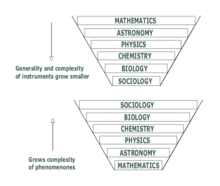
Comte's Theory of Science – According to him whole of sciences consists of theoretical and applied knowledge. Theoretical knowledge divides into general fields as physics or biological science, which are an object of his research and detailed such every bit phytology, zoology, or mineralogy. Main fields mathematics, astronomy, physics, chemistry, biological science, and sociology it is possible to order according to a decrescent range of research and complicatedness of theoretical tools what is connected with the growing complexity of investigated phenomenons. Following sciences are based on previous, for instance, to methodically coll chemical science, we must imply associate of physics, because all chemic phenomena are more than complicated than physical phenomena, are also from them dependent and themselves do not have on them an influence. Similarly, sciences classified as before, are older and more advanced from these which are presented as afterward.
The other universal law he chosen the "encyclopedic police". By combining these laws, Comte developed a systematic and hierarchical classification of all sciences, including inorganic physics (astronomy, earth science and chemistry) and organic physics (biological science and, for the first fourth dimension, physique sociale, later renamed Sociologie). Independently from Emmanuel Joseph Sieyès's introduction of the term in 1780, Comte re-invented "sociologie", and introduced the term as a neologism, in 1838. Comte had earlier used the term "social physics", but that term had been appropriated by others, notably by Adolphe Quetelet.
The most important thing to decide was the natural guild in which the sciences stand – not how they can be fabricated to stand, just how they must stand, irrespective of the wishes of anyone...This Comte accomplished by taking as the criterion of the position of each the degree of what he called "positivity", which is simply the caste to which the phenomena can be exactly determined. This, as may be readily seen, is too a mensurate of their relative complexity, since the exactness of a science is in inverse proportion to its complexity. The degree of exactness or positivity is, moreover, that to which it can exist subjected to mathematical demonstration, and therefore mathematics, which is not itself a physical science, is the general gauge past which the position of every scientific discipline is to be determined. Generalizing thus, Comte found that there were v great groups of phenomena of equal classificatory value but of successively decreasing positivity. To these, he gave the names: astronomy, physics, chemical science, biological science, and folklore.
This thought of a special science (not the humanities, not metaphysics) for the social was prominent in the 19th century and not unique to Comte. Information technology has recently been discovered that the term "folklore" (as a term considered coined by Comte) had already been introduced in 1780, albeit with a unlike meaning, by the French essayist Emmanuel Joseph Sieyès (1748–1836).[13] The ambitious (or many would say 'grandiose') ways that Comte conceived of this special science of the social, however, was unique. Comte saw this new science, sociology, as the concluding and greatest of all sciences, one which would include all other sciences and integrate and relate their findings into a cohesive whole. Information technology has to be pointed out, however, that he noted a seventh science, one even greater than folklore. Namely, Comte considered "Anthropology, or true science of Homo [to be] the terminal gradation in the Grand Hierarchy of Abstract Science."[14]

The motto Ordem e Progresso ("Order and Progress") in the flag of Brazil is inspired past Auguste Comte'southward motto of positivism: L'amour pour principe et l'ordre pour base of operations; le progrès pour merely ("Love as a principle and gild equally the basis; Progress as the goal"). Several of those involved in the military coup d'état that deposed the Empire of Brazil and proclaimed Brazil to be a democracy were followers of the ideas of Comte.[xv]
Comte's explanation of the Positive philosophy introduced the of import relationship between theory, do, and man agreement of the earth. On page 27 of the 1855 printing of Harriet Martineau'south translation of The Positive Philosophy of Auguste Comte, nosotros see his observation that, "If it is true that every theory must exist based upon observed facts, it is equally true that facts tin not be observed without the guidance of some theories. Without such guidance, our facts would be desultory and fruitless; we could non retain them: for the virtually role, we could not even perceive them."[16]
Comte'due south emphasis on the interconnectedness of social elements was a forerunner of modern functionalism. All the same, every bit with many others of Comte's time, certain elements of his piece of work are now viewed as eccentric and unscientific, and his g vision of folklore as the centerpiece of all the sciences has non come to fruition.
His emphasis on a quantitative, mathematical basis for decision-making remains with u.s.a. today. It is a foundation of the modernistic notion of Positivism, modern quantitative statistical analysis, and business concern decision-making. His description of the standing cyclical relationship between theory and practice is seen in modern business concern systems of Total Quality Management (TQM) and Continuous Quality Improvement where advocates depict a continuous bicycle of theory and exercise through the four-part cycle of Plan-Exercise-Bank check-Human activity (PDCA, the Shewhart cycle). Despite his advocacy of quantitative analysis, Comte saw a limit in its power to help explain social phenomena.
The early on folklore of Herbert Spencer came virtually broadly every bit a reaction to Comte; writing after diverse developments in evolutionary biology, Spencer attempted to reformulate the discipline in what we might now describe as socially Darwinistic terms.
Comte'due south fame today owes in function to Émile Littré, who founded The Positivist Review in 1867. Debates keep to rage, yet, as to how much Comte appropriated from the work of his mentor, Henri de Saint-Simon.
Auguste Comte did non create the idea of Sociology, the report of guild, patterns of social relationships, social interaction, and civilization, but instead, he expanded it profoundly. Positivism, the principle of conducting sociology through empiricism and the scientific method, was the principal mode that Comte studied sociology. He split sociology into two different areas of report. One, social statics, how society holds itself together, and two, social dynamics, the report of the causes of societal changes. He saw these areas as parts of the same system. Comte compared society and folklore to the man torso and beefcake. "Comte ascribed the functions of connection and boundaries to the social structures of language, organized religion, and division of labor."[ citation needed ] Through language, everybody in society, both past, and nowadays, can communicate with each other. Organized religion unites lodge under a common belief system and functions in harmony under a organization. Finally, the sectionalization of labor allows everyone in the guild depends upon each other.
The Utopian Projection [edit]
Comte is often disregarded when talking well-nigh utopia. Nevertheless, he made many contributions to utopian literature and influenced the modern-solar day argue. Some intellectuals allude to the fact that the utopian system of modern life "served as a catalyst for diverse world-making activities during the nineteenth and early twentieth centuries" (Willson, 1000. 2019) In this utopian project, Comte introduces iii major concepts: altruism, sociocracy, and the organized religion of Humanity. Altruism termed coined past Comte in the 19th century "a theory of acquit that regards the skilful of others equally the terminate of moral action." (Britannica, T, 2013). Furthermore, Comte explains sociocracy as the governance by people who know each other, friends, or allies. After the French revolution, Comte was looking for a rational basis for regime, subsequently developing the Positivism philosophy he developed sociocracy to the "scientific method" of the regime.
The religion of humanity [edit]

In later years, Comte developed the Religion of Humanity for positivist societies to fulfil the cohesive role one time held by traditional worship. In 1849, he proposed a calendar reform chosen the 'positivist calendar'. For close associate John Stuart Mill, it was possible to distinguish between a "good Comte" (the author of the Class in Positive Philosophy) and a "bad Comte" (the writer of the secular-religious system).[11] The system was unsuccessful but met with the publication of Darwin'southward On the Origin of Species (1859) to influence the proliferation of various Secular Humanist organizations in the 19th century, specially through the work of secularists such every bit George Holyoake and Richard Congreve. Although Comte'south English followers, including George Eliot and Harriet Martineau, for the virtually function rejected the total gloomy panoply of his system, they liked the thought of a organized religion of humanity and his injunction to "vivre pour autrui" ("live for others"), from which comes the word "altruism".[17]
Law of three stages [edit]
Comte was agitated by the fact that no one had synthesized physics, chemistry, and biology into a coherent organisation of ideas, then he began an attempt to reasonably deduce facts about the social earth from the use of the sciences. Through his studies, he ended that the growth of the homo mind progresses in stages, then must societies. He claimed the history of society could be divided into three different stages: theological, metaphysical, and positive. The Law of three Stages, an evolutionary theory, describes how the history of societies is split into three sections due to new thoughts on philosophy. Comte believed that development was the growth of the human mind, splitting into stages and evolving through these stages. Comte concluded that society acts similarly to the mind.[xviii]
The police force is this: that each of our leading conceptions – each branch of our cognition – passes successively through iii different theoretical conditions: the Theological, or fictitious; the Metaphysical, or abstract; and the Scientific, or positive.
—A. Comte[19]
The Law of Three Stages is the development of society in which the stages have already occurred or are currently developing. The reason why at that place are newly developed stages after a sure time period is that the system "has lost its power" and is preventing the progression of civilization, causing complicated situations in society. 10.[twenty] The merely manner to escape the situation is for people within the civilized nations to turn towards an "organic" new social system. Comte refers to kings to show the complications of re-establishment in society. Kings feel the need to reorganize their kingdom, only many neglect to succeed because they practice non consider that the progress of civilization needs reform, not perceiving that there is zilch more perfect than inserting a new, more harmonious system. Kings fail to see the effectiveness of abandoning one-time systems because they do not understand the nature of the present crunch. Only in order to progress, there need to be the necessary consequences that come with it, which is caused by a "series of modifications, contained of the human volition, to which all classes of society contributed, and of which kings themselves have often been the first agents and about eager promoters".[20] The people themselves have the ability to produce a new system. This pattern is shown through the theological stage, metaphysical stage, and positive stage. The Police force of Three Stages is split up into stages, much like how the human mind changes from stage to stage. The three stages are the theological phase, the metaphysical stage, and the positive phase, also known as the Police force of 3 Stages. The theological stage happened earlier the 1300s, in which all societies lived a life that was completely theocentric. The metaphysical phase was when the society seeks universal rights and freedom. With the third and final stage, the positive stage, Comte takes a stand on the question, "how should the relations amongst philosophy of scientific discipline, history of scientific discipline, and sociology of scientific discipline be seen."[21] He says that sociology and history are non mutually exclusive, simply that history is the method of folklore, thus he calls folklore the "final science." This positive stage was to solve social bug and forcing these social issues to be fixed without intendance for "the volition of God" or "homo rights." Comte finds that these stages can be seen across different societies beyond all of history.
Theological Phase [edit]
The offset phase, the theological stage, relies on supernatural or religious explanations of the phenomena of human behavior considering "the human heed, in its search for the master and final causes of phenomena, explains the apparent anomalies in the universe as interventions of supernatural agents".[22] The Theological Stage is the "necessary starting point of human intelligence" when humans turn to supernatural agents as the crusade of all phenomena.[23] In this stage, humans focus on discovering absolute knowledge. Comte disapproved of this stage considering it turned to simple caption humans created in their minds that all phenomena were caused by supernatural agents, rather than human reason and experience. Comte refers to Bacon's philosophy that "in that location can be no real cognition except that which rests upon observed facts", just he observes that the archaic mind could not have thought that mode considering it would take only created a vicious circle between observations and theories.[23] "For if, on the one mitt, every positive theory must necessarily be founded upon observations, it is, on the other hand, no less true that, in order to observe, our mind has need of some theory or other".[23] Because the human being mind could non take thought in that way in the origin of human cognition, Comte claims that humans would have been "incapable of remembering facts", and would non have escaped the circumvolve if it were non for theological conceptions, which were less complicated explanations to human life.[23] Although Comte disliked this stage, he explains that theology was necessary at the beginning of the developing primitive mind.
The first theological country is the necessary starting betoken of human intelligence. The human listen primarily focuses its attention on the "inner nature of beings and to the first and concluding causes of all phenomena it observes." (Ferre 2) This ways that the mind is looking for the cause and outcome of an action that will govern the social world. Therefore, it "represents these phenomena every bit being produced by a direct and continuous activity of more or less numerous supernatural agents, whose arbitrary interventions explain all the apparent anomalies of the universe." (Ferre 2) This chief subset of the theological state is known every bit fetishism, where the phenomena must be caused and created by a theological supernatural beingness such as God, making humans view every effect in the universe every bit a direct volition from these supernatural agents. Some people believed in souls or spirits that possessed inanimate objects and practiced Animism. These natural spiritual beings who possessed souls and may be apart from the textile bodies were capable of interacting with humans, therefore requiring sacrifices and worship to please the agents. With all these new reasons behind phenomena, numerous fetishisms occur, needing several gods to continue to explain events. People brainstorm to believe that every object or effect has a unique god attached to it. This belief is chosen polytheism. The heed "substituted the providential activeness of a unmarried beingness for the varied play of numerous contained gods which have been imagined by the primitive mind." These Gods often took on both human and brute resemblance. In Egypt, in that location were multiple gods with animal body parts such as Ra, who had the caput of a hawk and had sun associations with the Egyptians. The polytheistic Greeks had several gods such every bit Poseidon who controlled the ocean and Demeter who was the goddess of fertility. Nonetheless, with all these new gods governing the phenomena of order, the brain tin get confused with the numerous gods it needs to think. The human being listen eliminates this trouble past believing in a sub-phase called monotheism. Rather than having multiple gods, there is merely 1 all-knowing and omnipotent God who is the center of power decision-making the globe. This creates harmony with the universe considering everything is under one ruler. This leaves no confusion of how to act or who is the superior ruler out of the several gods seen in polytheism. The theological state functions well as the start state of the mind when making a belief about an upshot because it creates a temporary placeholder for the cause of the action which can afterwards be replaced. By allowing the brain to think of the reason backside phenomena, the polytheistic gods are fillers that can be replaced by monotheistic gods. The theological stage shows how the primitive mind views supernatural phenomena and how it defines and sorts the causes. "The earliest progress of the human being listen could just have been produced by the theological method, the only method which tin develop spontaneously. Information technology lonely has the important property of offering united states a provisional theory,… which immediately groups the first facts, with its help, by cultivating our capacity for ascertainment, we were able to prepare the age of a wholly positive philosophy." (Comte 149)
Comte believed the theological phase was necessary because of the foundational belief that man's earliest philosophy of explanation is the deed of connecting phenomena around him to his ain actions; that man may "employ the study of external nature to his ain".[24] This first phase is necessary to remove mankind from the "vicious circumvolve in which it was confined by the two necessities of observing first, in guild to form conceptions, and of forming theories outset, in guild to observe".[24] Additionally, the theological stage is able to organize society by directing "the start social organization, as it start forms a arrangement of common opinions, and by forming such a system".[24] Though, according to Comte, information technology could non last, this stage was able to establish an intellectual unity that made an impressive political organization. The theological state was also necessary for human progress on business relationship that it creates a class in a club dedicated to "speculative activeness".[24] It is in this way that Comte sees the theological phase continue to exist into the Enlightenment. Comte momentarily admires the theological stage for its remarkable ability to enact this activity amidst a time when it was argued to exist impractical. It is to this stage that the man mind owes "the first effectual separation between theory and practice, which could take place in no other manner" other than through the institution provided past the theological stage.[24]
The Theological Phase is the stage that was seen primarily among the civilizations in the distant by. Having been used before the 1300s, this is a very basic view of the earth with little to no involvement in the earth of scientific discipline, and a globe of illusions and delusions, as Freud would put it. To seek the nature of all beings, mankind puts its focus on sentiments, feelings, and emotions. This turned mankind towards theology and the cosmos of gods to answer all their questions.
The Theological Stage is broken into three sections:
- Fetishism is the philosophy in which mankind puts the power of a god into an inanimate object. Every object could hold this power of a god, so it started to misfile those who believed in Fetishism and created multiple gods, and
- Polytheism is, in bones terms, the conventionalities in an order of multiple gods who rule over the universe. Inside polytheism, each god is assigned a specific thing in which they are the practiced of. Examples of this would be the Greek god, Zeus, the god of the sky/lightning, or Ra, the lord's day god, in Egyptian mythology. A grouping of priests was ofttimes assigned to these gods to offer sacrifices and receive blessings from those gods, just once more, because of the innumerable number of gods, information technology got confusing, and then civilization turned to Monotheism.
- Monotheism is the conventionalities in one, anointed God who rules over every aspect of the universe. The removal of an emotional and imaginational aspects of both Fetishism and Polytheism resulted in intellectual awakening. This removal allowed for the Enlightenment to occur as well as the expansion of the scientific globe. With the Enlightenment came many famous philosophers who brought about a great alter in the earth. This is the reason why "Monotheism is the climax of the theological stage of thinking."[25]
Metaphysical or Abstract Stage [edit]
The second phase, the metaphysical phase, is but a modification of the kickoff considering a supernatural cause is replaced by an "abstract entity";[22] information technology is meant to be a transitional phase, where at that place is the belief that abstruse forces control the behavior of human being beings. Because it is a transitional phase between the theological stage and the positive stage, Comte deemed it the to the lowest degree important of the three stages and was just necessary because the human mind cannot make the bound from the theological to the positive phase on its own.
The metaphysical stage is the transitional stage. Because "Theology and physics are so profoundly incompatible", and their "conceptions are so radically opposed in character", human intelligence must take a gradual transition.[23] Other than this, Comte says that there is no other employ for this stage. Although information technology is the least important stage, it is necessary because humans could not handle the significant change in thought from theological to positivity.[18] The metaphysical phase is just a slight modification of the previous stage when people believed in the abstract forces rather than the supernatural. The mind begins to notice the facts themselves, caused past the emptiness of the metaphysical agents through "over subtle qualification that all correct-minded persons considered them to exist just the abstruse names of the phenomena in question".[20] The heed becomes familiar with concepts, wanting to seek more, and therefore is prepared to move into the positive phase.
In understanding Comte'southward statement, it is of import to note that Comte explains the theological and positive stages beginning and merely so returns to explain the metaphysical stage. His rationale in this determination is that "whatsoever intermediate state can be judged but subsequently a precise analysis of two extremes".[24] Only upon arrival to the rational positive country can the metaphysical state be analyzed, serving but a purpose of aiding in the transition from the theological to a positive land. Furthermore, this state "reconciles, for a time, the radical opposition of the other two, adapting itself to the gradual decline of the i and the preparatory rise of the other".[24] Therefore, the transition between the two states is well-nigh unperceivable. Dissimilar its predecessor and successor, the metaphysical state does not have a strong intellectual foundation nor social power for a political arrangement. Rather is just serves to guide homo until the transition from imaginative theological land to rational positive state is consummate.
Positive stage [edit]
The final stage – the positive stage – is when the mind stops searching for the crusade of phenomena and realizes that laws exist to govern human being behavior and that this phase can be explained rationally with the apply of reason and observation, both of which are used to study the social world.[26] This phase relies on scientific discipline, rational thought, and empirical laws. Comte believed that this study of sociology he created was "the scientific discipline that [came] after all the others; and as the final science, it must presume the task of coordinating the development of the whole of knowledge"[22] because it organized all of homo beliefs.
The final, almost evolved stage is the positivist phase, the stage when humans requite up on discovering absolute truth, and turn towards discovering, through reasoning and observation, actual laws of phenomena.[20] Humans realize that laws exist and that the world tin can exist rationally explained through science, rational idea, laws, and ascertainment. Comte was a positivist, assertive in the natural rather than the supernatural, and and so he claimed that his time period, the 1800s, was in the positivist stage.[26] He believed that within this phase, there is a bureaucracy of sciences: mathematics, astronomy, terrestrial physics, chemical science, and physiology. Mathematics, the "science that relates to the measurement of magnitudes", is the almost perfect science of all, and is applied to the almost of import laws of the universe.[20] Astronomy is the most simple science and is the first "to be subjected to positive theories".[23] Physics is less satisfactory than astronomy, because information technology is more circuitous, having less pure and systemized theories. Physics, as well equally chemistry, are the "general laws of the inorganic world", and are harder to distinguish.[20] Physiology completes the arrangement of natural sciences and is the most important of all sciences because it is the "only solid basis of the social reorganization that must terminate the crisis in which the nearly civilized nations have constitute themselves".[23] This stage will fix the bug in current nations, assuasive progression and peace.
It is through ascertainment that humanity is able to gather noesis. The only way within gild to gather evidence and build upon what we practise not already know to strengthen club is to observe and experience our situational environs. "In the positive state, the mind stops looking for causes of phenomena, and limits itself strictly to laws governing them; likewise, absolute notions are replaced by relative ones," [27] The imperfection of humanity is not a result of the way we recall, rather our perspective that guides the way we retrieve. Comte expresses the idea that we have to open our eyes to different ideas and means to evaluate our surroundings such as focusing outside of the simple facts and abstract ideas simply instead dive into the supernatural. This does not brand mean that what is around the states is non critical to look out for every bit our observations are critical assets to our thinking. The things that are "lost" or knowledge that is in the past are still relevant to contempo noesis. It is what is earlier our time that guides why things are the way they are today. We would always be relying on our own facts and would never hypothesize to reveal the supernatural if we do not notice. Observing strives to further our thinking processes. Co-ordinate to Comte, "'The dead govern the living,' which is likely a reference to the cumulative nature of positivism and the fact that our current world is shaped by the actions and discoveries of those who came earlier us,"[ commendation needed ] As this is true, the observations but relevant to humanity and not abstractly related to humanity are distinct and seen situationally. The situation leads to homo ascertainment every bit a reflection of the tension in society can exist reviewed, overall helping to heighten noesis evolution. Upon our observation skills, our thinking shifts. Equally thinkers and observers, nosotros switch from trying to identify truth and turn toward the rationality and reason nature brings, giving u.s.a. the ability to observe. This distinct switch takes on the transition from the abstract to the supernatural. "Comte's nomenclature of the sciences was based upon the hypothesis that the sciences had adult from the understanding of simple and abstruse principles to the understanding of complex and physical phenomena."[28] Instead of taking what nosotros believe to be true we turn it around to utilise the phenomena of science and the observation of natural law to justify what nosotros believe to be true within society. The condensing and formulation of human cognition is what Comte drives us toward to ultimately build the strongest society possible. If scientists exercise not have the adventure to research why a certain animal species are going singled-out and their facts researched by those in the past are no longer true of the nowadays, how is the information supposed to abound? How are nosotros to gain more knowledge? These facts of life are valuable, but it is beyond these facts that Comte gestures us to wait to. Instead of the culmination of facts with little sufficiency, knowledge birthday takes on its role in the realm of scientific discipline. In connection to science, Comte relates to scientific discipline in two specific fields to rebuild the construction of human knowledge. Every bit science is broad, Comte reveals this scientific classification for the sake of thinking and the future organization of guild. "Comte divided folklore into ii main fields, or branches: social statistics, or the study of the forces that hold guild together; and social dynamics, or the study of the causes of social change," [28] In doing this, social club is reconstructed. By reconstructing human thinking and observation, societal operation alters. The attention is drawn to science, hypothesis', natural law, and supernatural ideas, allows sociology to be divided into these two categories. By combining the uncomplicated facts from the abstract to the supernatural and switching our thinking towards hypothetical observation, the sciences culminate in society to formulate sociology and this new societal partitioning. "Every social arrangement… aims definitively at directing all special forces towards a full general effect, for the exercise of a general and combined activity is the essence of the society," [29] Social phenomena Comte believed can be transferred into laws and that systemization could become the prime guide to folklore so that all tin maintain cognition to continue building a strong intellectual society.
To continue building a stiff intellectual society, Comte believed the building or reformation requires intricate steps to achieve success. First, the new lodge must be created after the old society is destroyed considering "without…devastation no adequate conception could be formed of what must exist washed,".[30] Essentially a new order cannot exist formed if it is constantly hindered by the ghost of its past. On the aforementioned terms, there will be no room for progress if the new society continues to compare itself to the old society. If humanity does not destroy the old social club, the sometime club will destroy humanity.
Or on the other hand, if one destroys the erstwhile society, "without always replacing it, the people march onwards towards total anarchy,".[30] If the society is continuously chipped away without beingness replaced with new ideal societal structures, then society will fall deeper back into its former faults. The burdens will grow deep and entangle the platforms for the new social club, thus prohibiting progress, and ultimately fulfilling the cursed seesaw of remodeling and destroying society. Hence, according to Comte, to pattern a successful new society, 1 must proceed the balance of reconstruction and deconstruction. This balance allows for progress to continue without error.
Predictions [edit]
Auguste Comte is well known for writing in his book The Positive Philosophy that people would never learn the chemical composition of the stars. This has been called a very poor prediction regarding human limits in science. In xxx years people were beginning to acquire the composition of stars through spectroscopy.[31] [32]
Bibliography [edit]
- A general view of positivism [Discours sur l'Camaraderie positif 1844] London, 1856 Internet Archive
- Bridges, J.H. (tr.); A General View of Positivism; Trubner and Co., 1865 (reissued past Cambridge University Printing, 2009; ISBN 978-1-108-00064-2)
- Congreve, R. (tr.); The Canon of Positive Religion; Kegan Paul, Trench, Trübner and Co., 1891 (reissued by Cambridge University Press, 2009; ISBN 978-1-108-00087-1)
- with Gertrud Lenzer. Auguste Comte and Positivism the Essential Writings. Transaction Publishers, 1998.
- Martineau, H. (tr.); The Positive Philosophy of Auguste Comte; ii volumes; Chapman, 1853 (reissued past Cambridge University Press, 2009; ISBN 978-1-108-00118-2) (only note that Cambridge University Press said "Martineau'southward abridged and more easily digestible version of Comte'southward work was intended to be readily accessible to a broad general readership, peculiarly those she felt to exist morally and intellectually adrift", so this is not really Comte'south own writings)
- Jones, H.South. (ed.); Comte: Early Political Writings; Cambridge University Press, 1998; ISBN 978-0-521-46923-4
- System of Positive Polity; diverse publishers
- Cours de Philosophie Positive, Tome II; Bachelier, Paris, 1835, The Project Gutenberg eBook of Cours de philosophie positive (2/half-dozen), par Auguste Comte; scans of the six volumes are at Projet Gallica
- with Ferré Frederick. Introduction to Positive Philosophy. Hackett Pub. Co., 1988.
- with H. S. Jones. Early Political Writings. Cambridge University Printing, 2003.
Notes [edit]
- ^ a b Pickering (2006), p. 192ff.
- ^ Pickering (2009b), pp. 216 and 304.
- ^ "Auguste Comte | Biography, Books, Sociology, Positivism, & Facts".
- ^ Sutton, Michael (1982). Nationalism, Positivism, and Catholicism. The Politics of Charles Maurras and French Catholics 1890–1914 . Cambridge: Cambridge Academy Press. ISBN978-0521228688. esp. Chapters i and 2
- ^ a b c d Chisholm, Hugh, ed. (1911). . Encyclopædia Britannica. Vol. 6 (11th ed.). Cambridge University Press. pp. 814–822.
- ^ "Auguste Comte". The Stanford Encyclopedia of Philosophy. Metaphysics Research Lab, Stanford University. 2018.
- ^ "The Founders of Sociology". www.cliffsnotes.com . Retrieved 14 May 2019.
- ^ http://www.historyguide.org/intellect/lecture25a.html#course[ bare URL ]
- ^ "altruism (due north .)". Online Etymology Dictionary . Retrieved 21 Baronial 2013.
- ^ "Rencontre avec Annie Petit "Auguste Comte"". Montpellier Agglomeration. nineteen October 2007. Archived from the original on 15 Feb 2009. Retrieved xv October 2008.
Né à Montpellier, brillant élève du Lycée Joffre..." Translation: "Born in Montpellier, shining student of the Lycée Joffre...
- ^ a b "Auguste Comte". Stanford Encyclopaedia: Auguste Comte. plato.stanford.edu. Metaphysics Research Lab, Stanford University. 2018.
- ^ Giddens, Positivism and Sociology, 1
- ^ Des Manuscrits de Sieyès. 1773–1799, Volumes I and Two, published by Christine Fauré, Jacques Guilhaumou, Jacques Vallier et Françoise Weil, Paris, Champion, 1999 and 2007. See too Jacques Guilhaumou, Sieyès et le non-dit de la sociologie: du mot à la chose, in Revue d'histoire des sciences humaines, Number 15, November 2006. Naissances de la science sociale.
- ^ 1874 translation of Organisation of Positive Polity, Vol. II, pages 356–347, cited in Urbanowicz, Charles F. 1992. "Iv-Field Commentary". Anthropology Newsletter. Volume 33, Number nine, page 3.
- ^ "BRAZIL: Order and Progress". wais.stanford.edu.
- ^ Comte, A. b (1974 reprint). The positive philosophy of Auguste Comte freely translated and condensed by Harriet Martineau. New York: AMS Press. (Original work published in 1855, New York: Calvin Blanchard, p. 27.b)
- ^ "Comte'due south secular religion is no vague effusion of humanistic piety, merely a complete system of belief and ritual, with liturgy and sacraments, priesthood and pontiff, all organized around the public veneration of Humanity, the Nouveau M-Être Suprême (New Supreme Great Being), later on to exist supplemented in a positivist trinity by the M Fétish (the Globe) and the 1000 Milieu (Destiny)" According to Davies (p. 28-29), Comte'south ascetic and "slightly dispiriting" philosophy of humanity viewed as lonely in an indifferent universe (which can only be explained by "positive" science) and with nowhere to turn but to each other, was even more influential in Victorian England than the theories of Charles Darwin or Karl Marx.
- ^ a b Delaney, Tim. "Auguste Comte". Quango for Secular Humanism. Council for Secular Humanism, Oct.-Nov. 2003.
- ^ From The Positive Philosophy of Auguste Comte (trans. Harriet Martineau; London, 1853), Vol. I, p. 1.
- ^ a b c d due east f Comte, Auguste, and Gertrud Lenzer. Auguste Comte and Positivism: The Essential Writings. New York: Harper & Row, 1975. Print.
- ^ Bourdeau, Michel. "Auguste Comte." Stanford Encyclopedia of Philosophy, Stanford University, 8 May 2018, plato.stanford.edu/entries/comte/.
- ^ a b c Bourdeau, Michel. Auguste Comte. Stanford University. http://plato.stanford.edu/entries/comte/ [28 April 2016].
- ^ a b c d e f one thousand "Auguste Comte." Columbia Electronic Encyclopedia, 6Th Edition (2015): 1. MAS Ultra Schoolhouse Edition. Web.
- ^ a b c d e f chiliad Lenzer, Gertrud (1998). Auguste Comte and Positivism: The Essential Writings. Transaction Publishers. pp. 286, 289, 292.
- ^ Priya, Rashmi. "Law of 3 Stages: The Corner Stone of Auguste Comte's." Your Article Library, 1 December 2014, www.yourarticlelibrary.com/sociology/police force-of-three-stages-the-corner-stone-of-auguste-comtes/43729.
- ^ a b Delaney, Tim. Auguste Comte. Council for Secular Humanism, 2003.
- ^ Bourdeau, Michel. "Auguste Comte". Stanford Encyclopedia of Philosophy . Retrieved 22 May 2019.
- ^ a b Fletcher, Ronald. "Auguste Comte". Encyclopedia Britannica. Encyclopedia Britannica. Retrieved 22 May 2019.
- ^ Comte, Lenzer, Auguste, Gertrud (1975). Auguste Comte and Positivism. Harper and Row.
- ^ a b Comte, Auguste (1998). Auguste Comte and positivism : the essential writings. Transaction Publishers. ISBN0-7658-0412-3. OCLC 473779742.
- ^ How do we know the composition of stars?
- ^ "Comte on Astronomy". www.faculty.virginia.edu.
Sources [edit]
- Mary Pickering, Auguste Comte, Volume 1: An Intellectual Biography, Cambridge University Press (1993), Paperback, 2006.
- Mary Pickering, Auguste Comte, Book 2: An Intellectual Biography, Cambridge University Printing, 2009a.
- Mary Pickering, Auguste Comte, Book iii: An Intellectual Biography, Cambridge University Press, 2009b.
gordon childe urban revolution
Further reading [edit]
- Henri Gouhier, La vie d'Auguste Comte, Gallimard, 1931 lah
- Jean Delvolvé, Réflexions sur la pensée comtienne, Félix Alcan, 1932
- John Stuart Mill, Auguste Comte and Positivism, Trübner, 1865
- Laurent Fedi, Comte, Les Belles Lettres, 2000, réédition 2005
- Laurent Fedi, L'organicisme de Comte, in Auguste Comte aujourd'hui, M. Bourdeau, J.-F. Braunstein, A. Petit (dir), Kimé, 2003, pp. 111–132
- Laurent Fedi, Auguste Comte, la disjonction de l'idéologie et de fifty'État, Cahiers philosophiques, n°94, 2003, pp. 99–110
- Laurent Fedi, Le monde clos contre fifty'univers infini : Auguste Comte et les enjeux humains de l'astronomie, La Mazarine, n°13, juin 2000, pp. 12–15
- Laurent Fedi, La contestation du miracle grec chez Auguste Comte, in L'Antiquité grecque au XIXè siècle : united nations exemplum contesté ?, C. Avlami (dir.), Fifty'Harmattan, 2000, pp. 157–192
- Laurent Fedi, Auguste Comte et la technique, Revue d'histoire des sciences 53/two, 1999, pp. 265–293
- Mike Gane, Auguste Comte, London, Routledge, 2006.
- Henri Gouhier, La jeunesse d'Auguste Comte et la formation du positivisme, tome 1 : sous le signe de la liberté, Vrin, 1932
- Henri Gouhier, La jeunesse d'Auguste Comte et la formation du positivisme, tome two : Saint-Simon jusqu'à la restauration, Vrin
- Henri Gouhier, La jeunesse d'Auguste Comte et la formation du positivisme, tome 3 : Auguste Comte et Saint-Simon, Vrin, 1941
- Henri Gouhier, Oeuvres choisies avec introduction et notes, Aubier, 1941
- Georges Canguilhem, « Histoire des religions et histoire des sciences dans la théorie du fétichisme chez Auguste Comte », Études d'histoire et de philosophie des sciences, Vrin, 1968
- H.S. Jones, ed., Comte: Early Political Writings, Cambridge Academy Press, 1998
- Angèle Kremer-Marietti, Auguste Comte et la théorie sociale du positivisme, Seghers, 1972
- Angèle Kremer-Marietti, Auguste Comte, la scientific discipline sociale, Gallimard, 1972
- Angèle Kremer-Marietti, Le projet anthropologique d'Auguste Comte, SEDES, 1980, réédition 50'Harmattan, 1999
- Angèle Kremer-Marietti, L'anthropologie positiviste d'Auguste Comte, Lib. Honoré Champion, 1980
- Angèle Kremer-Marietti, Entre le signe et 50'histoire. L'anthropologie positiviste d'Auguste Comte, Klincksieck, 1982, réédition 50'Harmattan,1999
- Angèle Kremer-Marietti, Le positivisme, Coll."Que sais-je?", PUF, 1982
- Angèle Kremer-Marietti, Le concept de scientific discipline positive. Ses tenants et ses aboutissants dans les structures anthropologiques du positivisme, Méridiens Klincksieck, 1983
- Angèle Kremer-Marietti, Le positivisme d'Auguste Comte, L'Harmattan, 2006
- Angèle Kremer-Marietti, Auguste Comte et la scientific discipline politique, in Auguste Comte, Program des travaux scientifiques nécessaires pour réorganiserla société, 50'Harmattan, 2001
- Angèle Kremer-Marietti, Auguste Comte et fifty'histoire générale, in Auguste Comte, Sommaire appréciation de fifty'ensemble du passé moderne, 50'Harmattan, 2006
- Angèle Kremer-Marietti, Auguste Comte et la science politique, L'Harmattan, 2007
- Angèle Kremer-Marietti, Le kaléidoscope épistémologique d'Auguste Comte. Sentiments Images Signes, 50'Harmattan, 2007
- Realino Marra, La proprietà in Auguste Comte. Dall'ordine fisico alla circolazione morale della ricchezza, in «Sociologia del diritto», XII-2, 1985, pp. 21–53
- Pierre Macherey, Comte. La philosophie et les sciences, PUF, 1989
- Thomas Meaney, The Religion of Science and Its High PriestThe Religion of Science and Its High Priest, The New York Review of Books, 2012
- Jacques Muglioni, Auguste Comte: united nations philosophe pour notre temps, Kimé, Paris, 1995
- Annie Petit, Le Système d'Auguste Comte. De la scientific discipline à la organized religion par la philosophie, 2016, Vrin, Paris
- Gertrud Lenzer, Auguste Comte: Essential Writings (1975), New York Harper, Paperback, 1997
- Raquel Capurro, Le positivisme est united nations culte des morts: Auguste Comte, Epel, 1999 (traduit en français en 2001) : l'étude la plus récente sur la vie d'Auguste Comte, la vision sans complaisance d'une psychanalyste de l'école de Lacan
- Auguste Comte, Positive Philosophy of Auguste Comte (1855), translated by Harriet Martineau, Kessinger Publishing, Paperback, 2003; too available from the McMaster Archive for the History of Economical Thought: Volume One, Book Two, Volume Three
- Pierre Laffitte (1823–1903): Autour d'united nations centenaire, in Revue des Sciences et des Techniques en perspective, 2ème série, vol. viii, n°2, 2004, Brepols Publishers, 2005
- Zeïneb Ben Saïd Cherni, Auguste Comte, postérité épistémologique et ralliement des nations, Fifty'Harmattan, 2005
- Wolf Lepenies, Auguste Comte: die Macht der Zeichen, Carl Hanser, Munich, 2010
- Oséias Faustino Valentim, O Brasil e o Positivismo, Publit, Rio de Janeiro, 2010. ISBN 978-85-7773-331-six.
- Jean-François Eugène Robinet, Observe sur fifty'oeuvre et sur la vie d'Auguste Comte, par le Dr Robinet, son médecin et l'un de ses treize exécuteurs testamentaires, Paris : au siège de la Société positiviste, 1891. 3e éd.
- Jean-François Eugène Robinet, La philosophie positive: Auguste Comte et 1000. Pierre Laffitte, Paris : G. Baillière, [ca 1881].
- Auguste Comte Sociology Theory Explained
- Andrew Wernick, Auguste Comte and the Faith of Humanity, Cambridge University Printing, 2001.
- "Origins of Sociocracy". Sociocracy. Sociocracy.
- Britannica, T. Editors of Encyclopaedia. "Altruism". Encyclopedia Britannica. Encyclopaedia Britannica.
- Gane, Mike (2016). "Journey to Isidore". Revue européenne des sciences sociales. 52 (2): 43–67. doi:ten.4000/ress.3590.
- Gane, Mike (2006). Auguste Comte. 2 Park Square, Milton Park, Abingdon, Oxon OX14 4RN: Taylor & Francis. pp. 1–13. ISBN9780415385435.
{{cite volume}}: CS1 maint: location (link)
External links [edit]
- Works by Auguste Comte in eBook class at Standard Ebooks
- Works by Auguste Comte at Project Gutenberg
- Works by or well-nigh Auguste Comte at Cyberspace Annal
- Works by Auguste Comte at LibriVox (public domain audiobooks)

- Auguste Comte: Stanford Encyclopaedia of Philosophy
- Review materials for studying Auguste Comte
- J.H. Bridges, The Seven New Thoughts of the Positive Polity 1915
- Henri Gouhier, "Final Chapter – Life in the apprehension of the Grave", from The Life of Auguste Comte (1931). In Comte's final years, practicing his own faith.
- Auguste Comte quotes
- Auguste Comte at Discover a Grave
- Positivist Church building of Brazil
- The Three Cs and the Notion of Progress: Copernicus, Condorcet, Comte by Caspar J M Hewett
- The positive philosophy, Auguste Comte / freely translated and selected past Harriet Martineau, Cornell University Library Historical Monographs Drove – downloadable version
- Some selections from get-go lecture of Grade of Positive Philosophy
- Auguste Comte – High Priest of Positivism past Caspar Hewett
- Maison d'Auguste Comte
Source: https://en.wikipedia.org/wiki/Auguste_Comte
0 Response to "According to Auguste Comte, What Is the Job of the Sociologist?"
Post a Comment